
 It’s October, and here on the avocado ranch we’re eating Reed avocados. Have you ever tried a Reed? Have you ever seen them in a store or farmers’ market? If you have, you know that Califoria Reeds are one of the largest, creamiest, and most delicious avocados in the world! We look forward to late summer and early fall every year because that’s the time to eat the Reeds.
{6/19/2014 Added Note: Our 2014 Reeds are early … ready to eat in June already!}
 We used to have lots of Reed trees, but we cut many of them down and grafted them over to Hass variety. After they were cut to a 4-5 foot stump, a tree specialist made a slice into the tree and implanted a piece of bud wood from another tree. In this way we were able to use the root system already established, but grow a new tree of a different variety. We were sorry to say goodbye to so many beautiful Reed trees, but we had seen that the Hass variety was preferred by consumers and would bring us a better price.
It is expensive and labor-intensive to grow avocados, so we need to make enough money to pay for the water, fertilizer, and care throughout the year in order to stay in business. Reed avocados were just not popular enough to bring a good price. In the photo you can see the difference between the tall Reed tree and the shorter young Hass tree that was grafted onto a Reed stump. Hass trees like to spread out and become rounded in shape unless they are planted close together…then they will grow tall and form a canopy. Reed trees like to grow straight up, and don’t form a canopy as easily. It’s fun to walk up to a Reed tree because often there are avocados within arm’s length to pick!
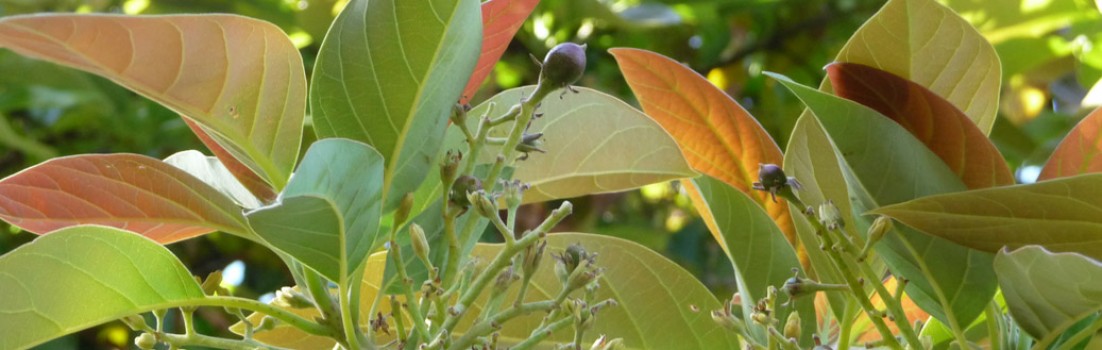
 This year’s crop of avocados are ready to pick, and next year’s crop is already growing on the tree! Can you see the tiny ones in the background?
 As the baby avocados grow bigger, the tree puts out new growth like an umbrella to shade the new fruit from the sun. Avocados bloom in the spring, then the tiny baby avocados begin to grow. It take all year for the fruit to reach full size and maturity so that it will ripen after it is picked. The Hass variety of avocado is ready to pick from December until late summer. These are the pear-shaped avocados with the bumpy skin that you probably see most often in the stores. Reed avocados are not ready to eat until late summer…July through October in southern California. When all of our Hass avocados have been picked, we know it’s time to start eating the Reeds.
 A Reed avocado is very creamy. The skin is thick and leather-like. To find out if a Reed is ready to eat, hold it in your hand and gently press your thumb. It will not feel rock hard, but will “give” just slightly. It “gives” less than other avocados with thinner skins, so it’s easy to wait too long with a Reed. They don’t turn black when they’re ripe either…so it takes a little practice to learn when a Reed is perfectly ready to eat. A skill worth learning!
 Late in the season, the fruit is very mature…higher oil content means the fruit is creamier, the color is a deeper gold, and sometimes the root has already started growing out of the seed! When the root is already growing like this one, balance the seed over a glass of water so the root can get a drink and watch it grow! (push some toothpicks into the side of the seed to hold it on top of the glass)
 One of the most exciting things about Reed avocados is that they come with their own bowl! The skin is so thick and strong that you can mash the avocado right in the skin, using it for a natural bowl! This has to be one of Mother Nature’s greatest accomplishments! The ultimate fast food! Just add salsa, or some seasoning…and dig in!
 Aren’t you glad you know something about Reed avocados now? You may see them in stores like Whole Foods in September and October. You will also find them in farmers’ markets in southern California. A large Reed avocado can make enough guacamole for several people, or provide sliced avocados for burgers and sandwiches. Since they’re larger than other avocados, we often eat only a half at a time. Even if the leftover half turns brown on top, just slice off the brown and enjoy the rest of the avocado underneath within one day or so. We’re having them on hamburgers for lunch! Wish you were here to join us!

P.S. and for breakfast:
Weekend Egg on Toast with California Reed Avocado!

141 Comments
Leave a reply →