
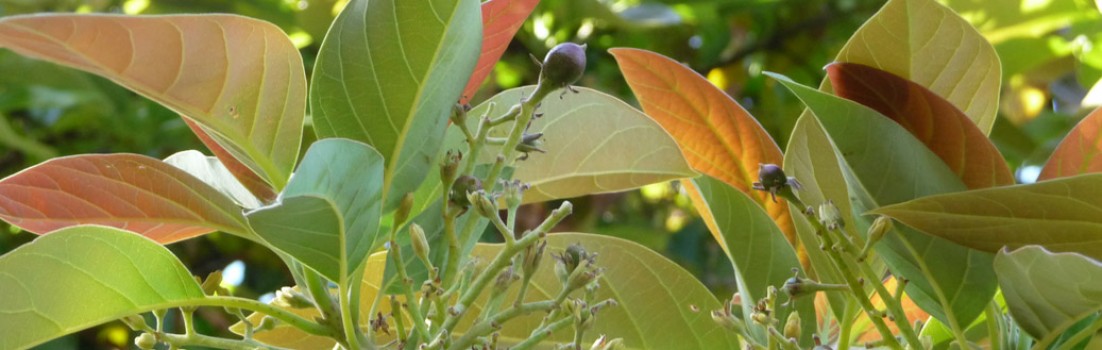
April is the month when everything happens at once in the avocado grove. Farmers begin to harvest the crop that has been growing for the past year on the trees. The avocado trees are in full bloom and baby avocados are beginning to appear. The constant humming of bees in the trees as they pollenate the flowers can be loud, and humming birds are flitting around too! See the little guy sitting high up in the tree?
The avocado flowers are beautiful little stars…clusters of optimism…nature’s little smiley faces.
And after a while, baby avocados appear … little green B-B’s that grow so quickly you can almost see them change before your eyes. New red leaves in the spring turn to green as they mature, ready to shade the new avocados from the hot summer sun.
The flowers eventually drop onto the ground, tiny reminders of the leaves that fall on the ground in New England. In the road are the signs that a lucky squirrel feasted on an avocado that fell and ripened under the trees, probably due to the winds two weeks ago. Fresh Hass avocados take up to two weeks to soften at this time of year. Need a ripe avocado? Look under the trees, and hope you beat the squirrels to the soft ones. Pick some every week and keep them on the kitchen counter if you want to be sure to have beautiful avocados to eat every day.
As the weather warms up, the colorful new avocado foliage becomes lush and green. Spring is the most exciting time to visit an avocado grove.
If you live in California, watch the avocado trees in your neighborhood. Have you noticed the flowers? The beautiful new foliage? Have you seen the flowers on the ground under the trees? Have you ever found an avocado that an animal has eaten? It’s springtime…let’s live in the moment! Let’s stop to smell the roses!
Used to monitor number of Google Analytics server requests when using Google Tag Manager
1 minute
_gid
ID used to identify users for 24 hours after last activity
24 hours
_ga_
ID used to identify users
2 years
_gali
Used by Google Analytics to determine which links on a page are being clicked
30 seconds
_ga
ID used to identify users
2 years
__utmx
Used to determine whether a user is included in an A / B or Multivariate test.
18 months
__utmv
Contains custom information set by the web developer via the _setCustomVar method in Google Analytics. This cookie is updated every time new data is sent to the Google Analytics server.
2 years after last activity
__utmz
Contains information about the traffic source or campaign that directed user to the website. The cookie is set when the GA.js javascript is loaded and updated when data is sent to the Google Anaytics server
6 months after last activity
__utmc
Used only with old Urchin versions of Google Analytics and not with GA.js. Was used to distinguish between new sessions and visits at the end of a session.
End of session (browser)
__utmb
Used to distinguish new sessions and visits. This cookie is set when the GA.js javascript library is loaded and there is no existing __utmb cookie. The cookie is updated every time data is sent to the Google Analytics server.
30 minutes after last activity
__utmt
Used to monitor number of Google Analytics server requests
10 minutes
__utma
ID used to identify users and sessions
2 years after last activity
_gac_
Contains information related to marketing campaigns of the user. These are shared with Google AdWords / Google Ads when the Google Ads and Google Analytics accounts are linked together.
90 days
Jetpack's built-in visitor analytics. It records page views, referring sites, search terms, and outbound link clicks, and also carries the shared visitor-tracking library used by Jetpack Instant Search and WooCommerce Analytics.
8 Comments
Leave a reply →